
Molecular sieve is a highly efficient dehydrating agent and desulfurizing agent in natural gas processing industry.
Natural gas processing is the industrial process of purifying raw natural gas to meet the quality standards required for pipeline distribution and commercial use. As an environmentally friendly adsorbent, molecular sieve is widely involved in natural gas purification processes, especially natural gas dehydration and natural gas sweetening.
Constituents of Raw Natural Gas
Raw natural gas contains heavy hydrocarbons, water vapor, sulfides, carbon dioxide, nitrogen and ammonia, among which water vapor and acid gases are harmful to pipelines and their use.
Therefore, according to the hydrocarbons content, natural gas can be divided into dry gas and wet gas, or lean gas and rich gas; according to the acid gases content, natural gas can be divided into sour gas and sweet gas.
Purposes of Natural Gas Purification
- Prevent pipeline blockage and corrosion
Natural gas containing carbon dioxide and hydrogen sulfide forms acid in the presence of water, which in turn corrodes pipelines and equipment, affecting the transportation and use safety of natural gas. Under certain conditions, natural gas hydrates are formed to block valves, pipelines and equipment, reduce pipeline transportation capacity, and cause freezing and blockage of downstream cryogenic units.
Therefore, unnecessary power consumption will be caused; and the calorific value of natural gas can be reduced.
- Ensure use safety and efficiency of natural gas
Acidic gases in natural gas may endanger human life when burned; when used as chemical raw materials, they will reduce catalyst activity and affect product quality.
- Improve calorific value and economic benefits
Separating and liquefying hydrocarbons above C3 can increase the combustion calorific value of natural gas, while producing by-products such as liquefied gas and light oil, bringing economic benefits.
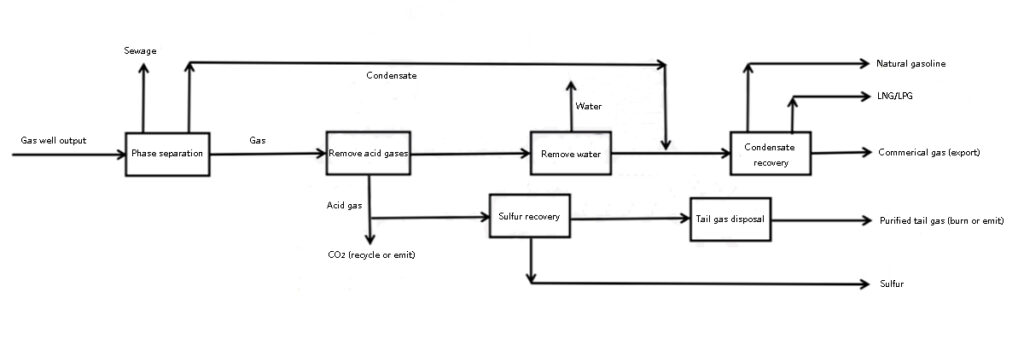
Natural Gas Purification Process
Raw natural gas may contain many by-products. And before the actual liquefaction process, the raw gas needs to be purified, i.e. the unwanted components need to be removed.
Types of Molecular Sieve for Natural Gas Processing
3A: Dehydration of unsaturated hydrocarbons and hydrocarbons containing H2S;
4A: Dehydration of saturated hydrocarbons;
5A: Removal of trace amount of H2S from an equimolar mixture of CH4 and CO2;
13X: Removal of H2O, CO2, H2S, etc.
Advantages of Molecular Sieve in Natural Gas Processing
- For natural gas sweetening
Molecular sieves have high adsorption capacity (larger specific surface area and pore volume) and can provide more active sites for the adsorption of sulfides;
Molecular sieves remove many types of substances. In addition to inorganic sulfur, they also have the ability to adsorb organic sulfur such as methyl mercaptan, ethyl mercaptan, propyl mercaptan, methyl sulfide and thiophene.
- For natural gas dehydration
Molecular sieves can deeply dry gases. Generally, their adsorption capacity is higher than other adsorbents, so the size of the drying tower can be reduced, and saving money;
Molecular sieves can effectively dry gases at higher temperatures;
Molecular sieves can selectively adsorb moisture to avoid co-adsorption of heavy hydrocarbons that render the adsorbent ineffective;
Molecular sieves is not easily damaged by liquid water, while adsorbents such as silica gel are easily broken when exposed to water.