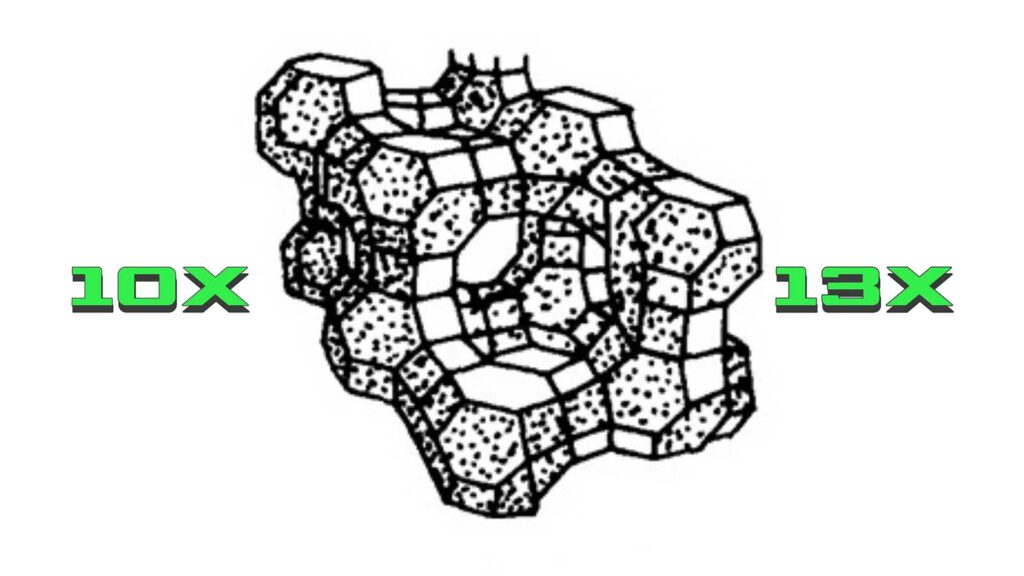
The main difference between 10X and 13X molecular sieves is their pore size and applications. And they are both type X crystal structure, due to their different pore sizes, industrial applications vary.
Chemical Knowledge of 10X and 13X Molecular Sieves
10X and 13X molecular sieves are both aluminosilicates, with a X-type crystal structure.
13X molecular sieve, is the sodium form of the type X crystal, also known as NaX molecular sieve. When Na+ in the 13X molecular sieve is partly exchanged by Ca2+, that is 10X molecular sieve, it is the calcium form of the type X crystal, also called CaX molecular sieve.
10X: 4/5CaO·1/5Na2O·Al2O3·(2.8±0.2) SiO2·(6-7)H2O
13X: Na2O·Al2O3·(2.8±0.2)SiO2·(6-7)H2O
10X: SiO2/Al2O3≈2.6-3.0
13X: SiO2/Al2O3≈2.6-3.0
10X: about 9A
13X: about 10A
Industrial Applications of 10X and 13X Molecular Sieves
10X molecular sieve, is mainly used for the adsorption separation of aromatics and paraffin refining. It is suitable for the separation of normal isoparaffins, the separation of oxygen and nitrogen in chemical, petroleum and natural gas industries. And 10X molecular sieve can also be used as catalysts and catalyst carriers.
13X molecular sieve, is mainly used for gas drying and purification, including purification of raw gas in air devices (removing water and carbon dioxide at the same time), desulfurization of liquid hydrocarbons and natural gas (removing hydrogen sulfide and mercaptans), and as a catalyst carrier. 13X molecular sieve is also widely used in the fields of medicine and drying of air compression systems.
SNOWPEAK Products of 10X and 13X Molecular Sieves