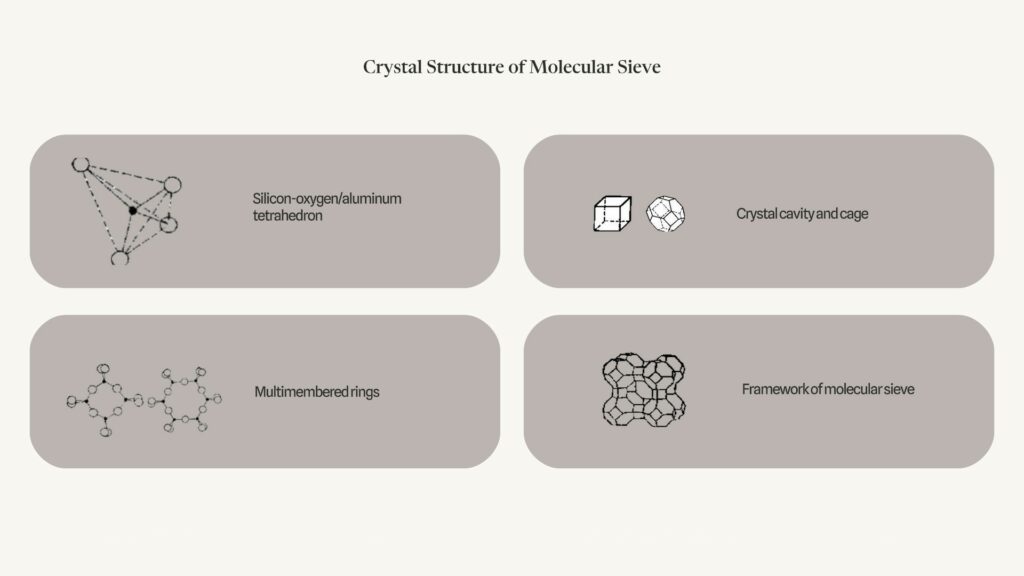
Molecular sieve is a kind of microporous aluminosilicate crystal with uniform pore size and extremely high specific surface area, good thermal stability, strong adsorption capacity, large internal surface area and high strength.
Different types of molecular sieves vary in chemical composition, thus their pore cavities and pore volumes differ greatly. And the size of molecules that can be adsorbed by a type of molecular sieves depends on the pore size.
Different Molecular Sieve Sizes
Molecular sieves can be divided into several sizes, each with its own pore size. A molecular sieve’s pore diameter can be expressed as a unit of distance or as a number of nanometres.
The microporous materials have pore diameters of less than 2 nm, and macroporous materials have pore diameters of greater than 50 nm, the mesoporous category thus lies in the middle with pore diameters between 2 and 50 nm. The most common sizes available in molecular sieves are 3A, 4A, 5A, and 13X.
Pore size is 3A (0.3 nanometers), mainly used for water adsorption, does not adsorb any molecules with a diameter greater than 3A, and is commonly used for deep drying and refining in the petroleum and chemical industries.
Pore size is 4A (0.4 nanometers), can adsorb water, methanol, ethanol, hydrogen sulfide, carbon dioxide and other molecules with a critical diameter not greater than 4A, and has a higher selective adsorption performance for water than other molecules.
Pore size is 5A (0.5 nanometers), mainly used for separation of normal and isomerized hydrocarbons, pressure swing adsorption separation and co-adsorption of water and carbon dioxide.
Pore size is 10A (1 nanometer), adsorbs any molecules less than 10A, is commonly used for catalyst carriers, co-adsorption of water and carbon dioxide, co-adsorption of water and hydrogen sulfide gas, and is mainly used for drying of medicine and air compression systems.
Common Molecules and Their Critical Diameters
Molecule | Diam.(Å) | Molecule | Diam.(Å) |
Helium | 2 | Propylene | 5 |
Hydrogen | 2.4 | Ethyl mercaptan | 5.1 |
Acetylene | 2.4 | 1-Butene | 5.1 |
Oxygen | 2.8 | trans-2-Butene | 5.1 |
Carbon monoxide | 2.8 | 1,3-Butadiene | 5.2 |
Carbon dioxide | 2.8 | Chlorodi fluoromethane | 5.3 |
Nitrogen | 3 | Thiophene | 5.3 |
Water | 3.2 | Isobutane to isodocosane | 5.6 |
Ammonia | 3.6 | Cyclohexane | 6.1 |
Hydrogen sulfide | 3.6 | Benzene | 6.7 |
Argon | 3.8 | Toluene | 6.7 |
Methane | 4 | p-Xylene | 6.7 |
Ethylene | 4.2 | Carbon tetrachloride | 6.9 |
Ethylene oxide | 4.2 | Chloroform | 6.9 |
Ethane | 4.4 | Neopentane | 6.9 |
Methanol | 4.4 | m-Xylene | 7.1 |
Methyl mercaptan | 4.5 | o-Xylene | 7.4 |
Propane | 4.9 | Triethylamine | 8.4 |
n-Butane to n-docosane | 4.9 |
How to Choose a Right Size of Molecular Sieve
Consider the molecules that need to be adsorbed or separated, smaller pore size molecular sieves have higher selectivity for certain molecules, while larger pore size molecular sieves have higher adsorption capacity for larger molecules.
Choose a molecular sieve whose pore size is slightly larger than the size of adsorbed molecules, to ensure efficient adsorption and prevent blockage during the industrial process.
Select molecular sieve with pore size best suited to the operating conditions of the industrial process, as some sizes may be more effective at higher temperatures and others at lower pressures.
Understand adsorption kinetics, including the rate at which molecules are adsorbed onto the molecular sieve, since the rate of adsorption or desorption matters much to the industrial process.
Think about the stability that molecular sieve offers, will it change or react with the compounds, in order to extend the cycle life of molecular sieve thus control the operating costs of industrial process.
SNOWPEAK, a professional manufacturer, who dedicated itself to molecular sieve solutions for more that 35 years, supplies high quality molecular sieves with varied sizes that best suitable for your applications and industrial processes.